Overview
Before we officially enter our partnership, I want to be sure you are clear about what the Performance Horse Program is all about and that includes knowing exactly what your bills will be and what I will do for you. Throughout my career, I’ve been a staunch believer in always being transparent in my business transactions and spelling out every detail of what is to be expected in a partnership with me. I’d always rather under promise and over deliver and exceed your expectations than over promise and under deliver and lose the trust you placed in me. I want you to be aware of what I’ll be doing for you as the trainer of your performance horse and the commitment I’m putting into our partnership.
Please note that the below costs are if you exclusively own the horse. If you are in a 50/50 partnership with me, the bills will be split equally between the two of us.
MONTHLY COSTS:
Training/Maintenance$1,000/$1,000
Board $1,100
Cold-Water Spa Therapy $400
Cattle Fee $300
FARRIER:
Each Shoeing $200-$300
YEARLY COSTS:
Dental $200-$300
Blanketing/Boots $600
Vaccines & De-Worming $150
Training
$1,000/Month
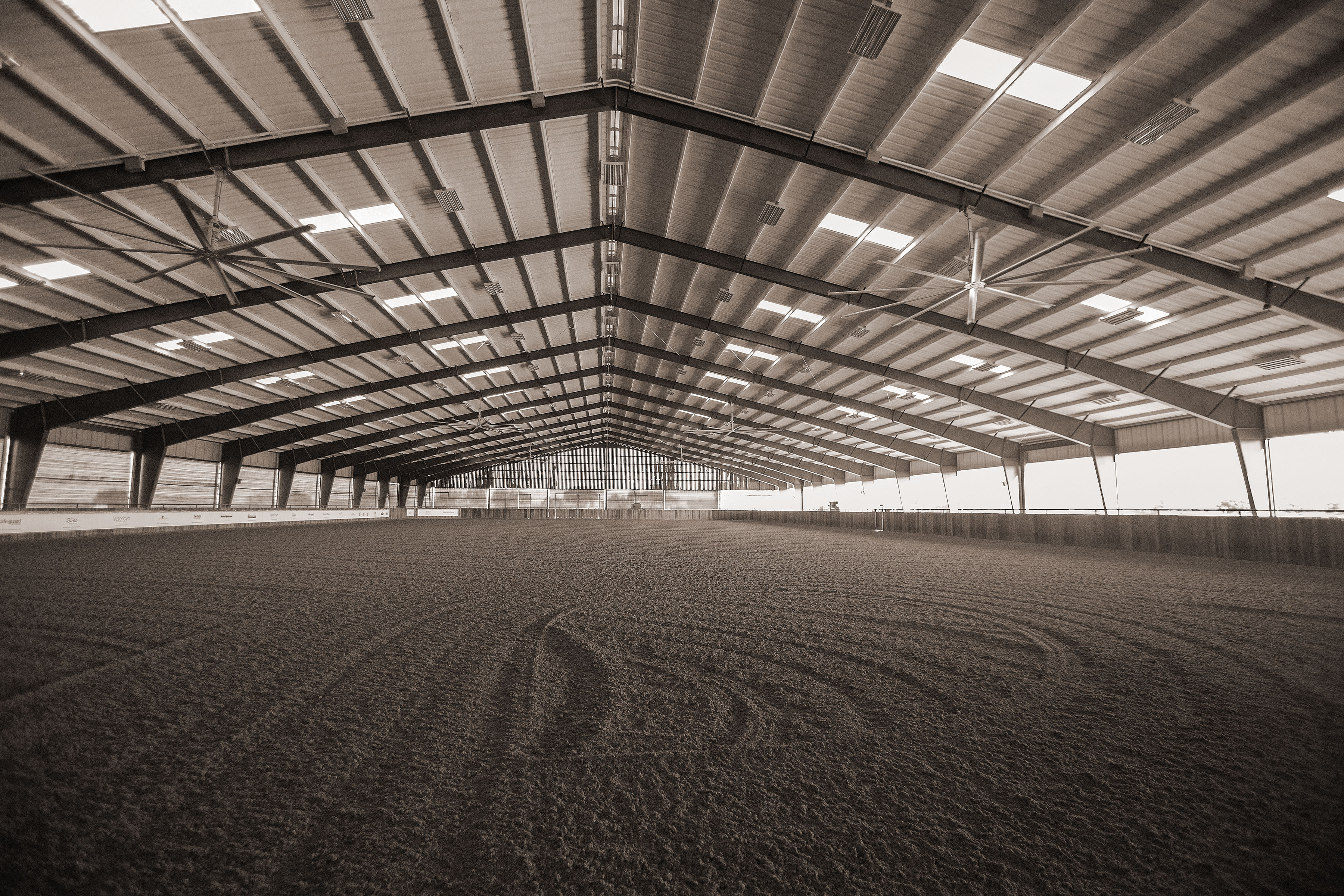
Your performance horse will be in training on average five days per week for almost 24 months. The reality is that not every horse lives up to his bloodlines to compete at the highest level of competition. Below is the process in which horses make it through the program.
1st Cut – after 4 months of riding
A well-broke horse in any discipline needs a great foundation. You build a great foundation by riding the horse consistently five to six times a week for at least four months straight. In this time, we have the horses riding really well, they’re soft and supple, with a great foundation. After four months, I make the first serious cut to the performance horse prospects. My job is to look into a crystal ball and try to figure out which prospects are going to be great performance horses and win world championships and which ones are not going to make that level and will be better suited towards a different discipline or event. Trainers are notorious for keeping horses in training month after month, when they know very well that the horse doesn’t have the talent or ability to compete at the level the owner wants. You never have to worry about me keeping a horse around too long. Because I limit the number of horses I take into my program, I am extremely picky and selective about the horses I train. I’m looking for the best of the best – basically the great ones. Every month the horse is in training, I act as if it were my own money being spent, meaning I’m very careful where the money is spent and what the expenses are adding up to be. So the earlier I can cut a horse and keep the expenses as minimal as possible, the more I am protecting the customer and building a strong relationship. Four months does not sound like a long time to most horse trainers, but what takes most horse trainers 10 months to accomplish, we can get done in four months.
2nd Cut – after 12 months of riding
This is the next crucial point at which hard decisions have to be made. The training demands and mental and physical stresses grow considerably when the horse turns 3. At this point, the horses do one of two things: the great horses step up to the plate and take on these new challenges in stride and keep advancing in their training every day, and the horses that don’t have the heart and the desire to be great start to look for the easier way out. They will cheat you, become resentful in their training, and in general give you less effort and try. So if your horse makes the 12-month cut, there’s a pretty good chance that he’ll make it all the way through to the futurities. Is there a chance that in the middle of the horse’s 3-year-old year, we max out his potential and ability? The answer is yes. There is never anything that’s absolutely guaranteed until you actually get there. What we’re trying to do is not throw good money into a horse that won’t mentally or physically meet our high standards. That doesn’t mean that the horse has no use or is disregarded; it just means that we need to find a place where that horse can excel and be happy doing his job.
Maintenance
$1,000/Month
The 2- and 3-year-old years are the most intense of a performance horse’s training. After that, the training eases up and it’s important to have a good long-term program set in place. Our maintenance program is for older horses that are still being shown in their 4- , 5- , and 6-year-old years. The keys to keeping these horses happy in their jobs, sound and performing at their best, are to not override them, to keep training sessions fun and interesting for them and to keep them in top physical condition. He’ll receive regular turnout for his mental and physical wellbeing. While these horses have an active role in the program, it’s important that we don’t drill on them and ride them hard every single day because they’ll burn out and won’t last for years to come.
Cold-Water Spa Therapy
$400/month
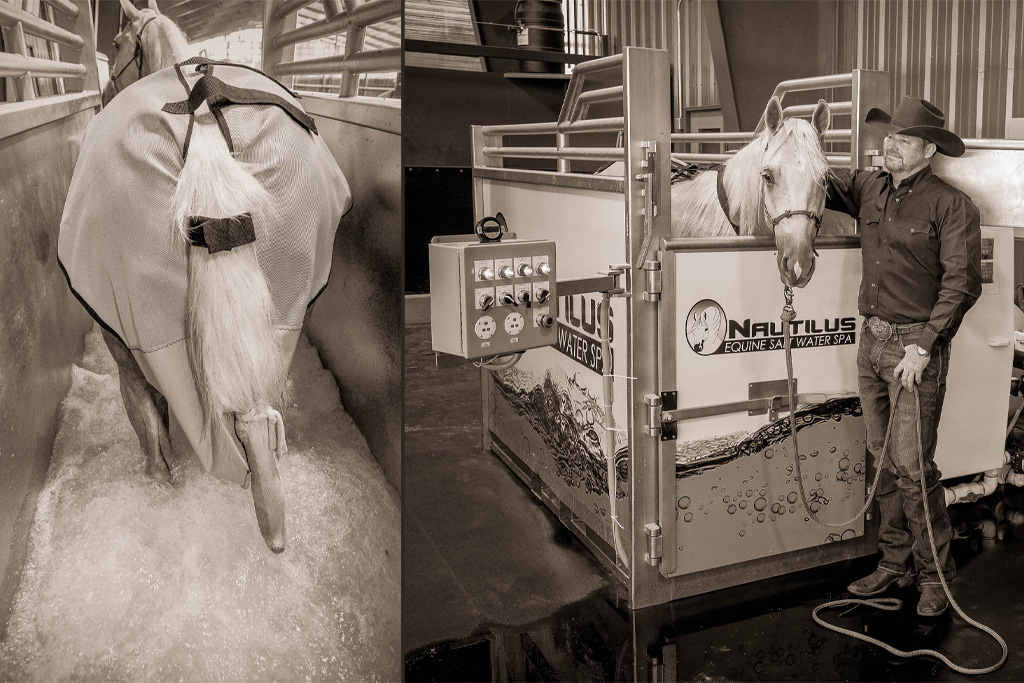
Horses begin using the equine spa when I take over their training, which is typically at the start of their 3-year-old year. The spa serves as a preventative measure and is used after each ride.
There’s no better preventative care for an athlete – horse or human – than good old fashioned ice therapy after a workout. It’s the best remedy for reducing inflammation and swelling in the world. All of the major stress on a horse’s body occurs from his hocks and knees down, so the better you can take care of his legs, the better he’ll perform.
Most trainers only use cold-water therapy after a horse has suffered an injury. I put my horses in the spa after each training session. The saltwater comes into the unit at 36 degrees Fahrenheit. I use the spa as a preventative measure to keep my horses sounder and happier throughout their careers.
Equine Walker Use
Included with training and maintenance fee
$400/month for horses not in training
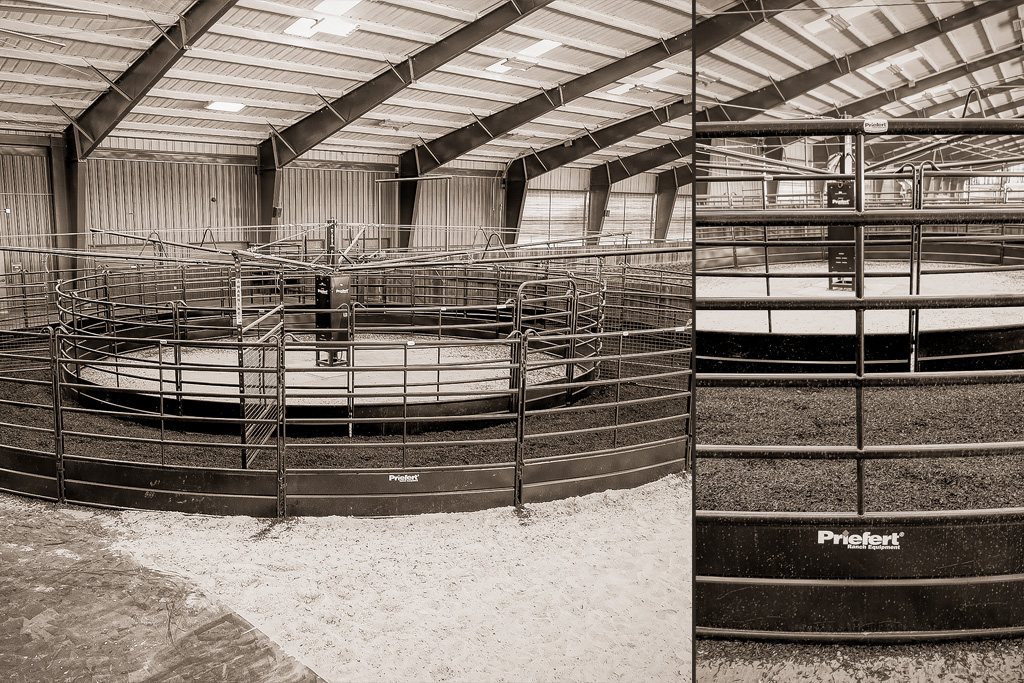
The Priefert Horse Walker is used daily to keep the horses’ fitness levels up. The best thing you can do for a well-trained horse is to keep him mentally and physically sharp and in good condition. The walker helps me to achieve both of those goals.
It’s also a handy piece of equipment to have around for a horse that’s on stall rest with light work because it offers a controlled way for the horse to exercise. A lot of injuries happen to horses on stall rest because they have pent up energy to burn off. When they’re finally exercised or turned out, they gallop off, kick up and twist their bodies and end up straining or tearing something.
While veterinarians and equine therapeutic centers typically charge $75/use of a walker, daily use of the walker is included in every horse’s training or maintenance fee.
Cattle Fee
$300/Month
Cow horses will be charged $300/month for cattle use. The fee helps to cover leasing and caring for the cattle. You won’t be charged the cattle fee unless your horse is working cows. Typically, I don’t start a horse on cows until late October of their 2-year-old year.
Hauling Horses to Shows to Season Them
$0.75/Mile
Starting in January of their 3-year-old year, the horses are hauled to shows to get them used to the show environment. In the industry, we call this “seasoning” the horses. While we don’t show the horses, we ride them around the practice pens and just let them get used to all the hustle and bustle that takes place at showgrounds. That way, six months later, when we do show them for the first time, they are completely confident in the environment. When it’s time to compete, they’re focused on the job at hand and ready to go.
When hauling horses to shows, whether to compete on them or season them, owners are billed $0.75 per mile to and from the event. They’re hauled in a state-of-the-art freight liner where their comfort and safety are top priority. For pricing reference, commercial horse transports around the country charge $1 plus per mile on average.
Board
$1,100/Month
During their 2-year-old year, performance horses in training are placed on full board and take advantage of all the amenities the ranch has to offer. I believe that the closer you can keep your 2-year-old horses to an environment that they’re used to when they enter training, it reduces stress and keeps them happier. All of the yearlings and 2-year-olds on the ranch are turned out in pastures, with the colts and fillies being separated. Not only is this good for the horses’ physical wellbeing, but horses are social animals and the more they can interact with each other in a herd, the happier and more mentally sound they are.
When horses on the ranch enter their 2-year-old year, nothing changes for them. Every day, the horses are caught up and fed, and five to six days a week, they are ridden. After their training sessions, they are hosed off and cared for, and then turned back out in the pasture. Keeping the horses turned out in a pasture keeps them happier and they just ride better. Two-year-olds that are kept in stalls come to training sessions fresher and need to be worked more and they can develop unwanted behaviors because they’re not allowed to interact with other horses.
Horses are blanketed throughout the year as required – winter blankets to keep hair short and summer sheets to avoid the horse’s coat from bleaching out.
A detailed nutrition program is laid out for each horse to include high-quality hay and grain.
You will be responsible for any additional supplements your horse requires, such as Glucosamine or Adequan, as well as de-worming and vaccinations as needed.
Around July 15 of the horse’s 2-year-old year, when hind shoes are put on him, he is moved to a stall in the show barn. This ensures that the horses don’t accidentally hurt each other and bringing them into the barn keeps their coats from getting bleached out by the sun. On each horse’s days off, they are turned out individually in an 1-acre pasture.
Farrier
$200 – 300/Per Shoeing
You’ve heard the saying: No hoof, no horse. It’s absolutely true. Equine feet vary from horse to horse and even from foot to foot on the same horse. A talented farrier provides the work we need to keep your horse’s hooves sound so he can perform at his best. Performance horses in training are put on a five-week shoeing schedule with our farrier who has many years of experience shoeing the very best working cow horses and cutting horses in the country.
Dental
$200 – 300/Year
Routine dental care is essential to your horse’s health and ensures he’s at the top of his game. Periodic examinations and regular maintenance, such as floating, are necessary. With proper dental care, your horse will be healthier and perform better. Once a year, each performance horse is scheduled an appointment with an equine dentist.
Veterinarian Care
Veterinarian care is an extremely important part of your horse’s success. These horses are like professional athletes and need to be treated as such, from their diet and training to their health care needs. They are not just a backyard, trail-riding horse. They are a professional athlete performing at the highest level of their sport. All veterinarian care, other than in an emergency situation in which I cannot reach you, will be pre-approved by you. For example, I’ll contact you and let you know that I believe your horse needs to be taken to the vet. You’ll OK my decision. Anytime the vet looks at your horse, he’ll contact you and give you an update about what he saw, positive or negative. You’ll also receive a follow-up phone call from me. This gives you the opportunity to be very hands-on with your horse’s well-being and care. I appreciate the fact that most owners trust me and don’t care to be contacted by the vet, but it’s important to me that you know where your money is going and how your horse is being cared for.
Your bill will be sent to me. I’ll approve the bill and pay it. Then you will be invoiced by Downunder Horsemanship, and we will include a copy of the original bill. That way you know that the fees were not marked up. This will give you confidence that I am on top of all of my horses’ care and know exactly how money is being spent.
If your horse needs to be hauled to the vet, there will be a flat $300 fee to the vet and a $300 fee back to the ranch. This fee covers mileage to and from my ranch in Arkansas to the veterinarian facility in Weatherford, Texas. If the vet comes out to the ranch to see your horse, you will be charged a farm call fee.
Blanketing/Boots
$600/Year
This fee is all encompassing to cover daily use and care of blankets, coolers, saddle pads, polo wraps and protective boots. Your horse will be blanketed throughout the year using blankets provided by Downunder Horsemanship to keep his coat healthy and to protect him from the elements. During each training session, your horse will wear boots to protect his legs. This is especially important as the horse’s training progresses and he begins performing advanced maneuvers. You’ll be billed this fee in January of each year and it will cover all of your horse’s needs for the year, including use of blankets in the winter months, sheets in the spring and summer, and coolers, as well as cleaning of the blankets and repairs and maintenance of all equipment.